
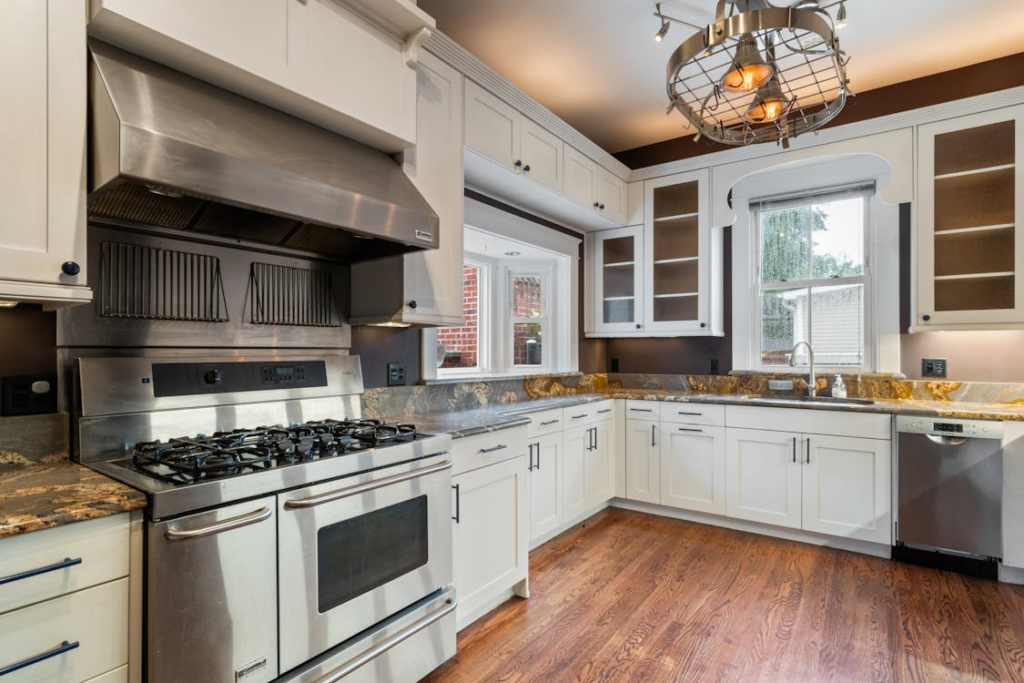
At present, if your top-of-the-line range leaves your kitchen hazy after cooking and your home smelling like last night’s dinner, your ventilation is quite faulty. Cooking, especially at high heat, releases pollutants like nitrogen dioxide, which the World Health Organization links to indoor air risks.
Here are some tweaks to fix your home’s airflow, control smoke, and keep your space clean, quiet, and comfy every single day.
1. Match Airflow to Heat, Not Guesswork
Begin with a guideline that’s actually effective; your kitchen hood needs to move enough air to keep up with your burner’s outputs. A growing number of HVAC experts take 100 CFM per 10,000 BTU as a rough estimate; actual cooking will most likely require even more ventilation.
Besides being just a number, airflow can determine the very atmosphere and efficiency of your kitchen. This is the factor that essentially engages you in space planning, particularly in open floor plans where poor airflow allows smoke to spread into the living areas. If your range’s heat corresponds to 60,000 BTU, you need to be targeting a minimum airflow of 600 CFM, and for heavy cooking, even closer to 900 CFM will do.
2. Size the Capture Area Like a Pro
Airflow alone will not save you if the hood does not capture the plume. Your hood has to be wider than the cooktop and deep enough to cover front burners, which release the most smoke.
This becomes critical when outfitting a kitchen with commercial-grade ranges, since these units produce higher heat loads and wider flame spread. Exploring specs like burner count and British Thermal Unit (BTU) ratings from sources and outfitting your kitchen with commercial-grade ranges helps you estimate real capture needs before you buy.
3. Duct Runs Can Make or Break Performance
Even an excellent fan will not work if the duct path is restrictive. So keep duct runs short, limit the number of turns, and use smooth metal ducts to decrease resistance.
The Home Ventilating Institute advises reducing the number of elbows and keeping the equivalent duct length low, because each bend decreases the efficiency of the airflow. If your plan requires a long way, bump up the fan power to make up for it, or think about changing the hood outlet location.
4. Do Not Ignore Make-up Air
High CFM systems pull air out fast, which can create negative pressure in your home. That pressure can backdraft combustion appliances or make doors harder to open.
Many building codes in the United States now require make-up air systems for hoods above 400 CFM. This simply replaces the air you remove, keeping your home balanced and your ventilation effective.
5. Baffle Filters Beat Mesh For Heavy Cooking
If you’re preparing meals using high temperatures or oils, go for stainless steel baffle filters. These filters will be able to capture grease more effectively and are easier to clean compared to mesh ones.
Baffle filters are the backbone of commercial kitchen ventilation since they are great at preventing fires and keeping the kitchen ventilated even after some time has elapsed between cleanings. Besides, you can put them in your dishwasher, so keeping them in good condition regularly won’t be a hassle.
6. Control the Noise Without Losing Power
Loud hoods often get used less, which defeats their purpose. Look for remote blowers or inline fans that move the motor away from the hood area.
You can also check sone ratings, a quieter system encourages consistent use, especially in open concept homes where noise travels easily.
7. Island vs Wall Hoods Need Different Strategies
Often, island hoods require more airflow because they lack surrounding walls to help contain smoke. That’s why experts often recommend increasing CFM by 20 to 40 percent for island installations.
Also, wall-mounted hoods can benefit from the wall acting as their barrier, which improves capture efficiency, especially when taking off heavy cooking fumes and smells. Choosing the right type for your layout prevents smoke from drifting into living spaces.
8. Induction Changes the Equation, But Not Entirely
Induction cooktops generate less heat around the kitchen, but they still give off steam, grease, and odors. You might be able to lower the CFM a bit compared to gas, but proper capture and ducting are still needed to make sure the system works efficiently.
You need not think that you can go without ventilation altogether, especially if cooking is a regular thing for you or you often use high-heat techniques.
9. Maintenance is Your Hidden Performance Booster
Even the best system fails when clogged with grease. So, clean your filters every few weeks if you cook often, and inspect ducts at least once a year to make sure they’re in tip-top shape.
According to the National Fire Protection Association, one of the leading causes of home fires in the US is cooking, and grease buildup can contribute to ignition when it accumulates on surfaces or inside ventilation systems.
Build a kitchen That Clears the Air Fast
Your goal is pretty straightforward: grab smoke right where it is coming from and get it out quickly. Once you know how to measure airflow properly, you can design clever duct routes and keep your system working well, making sure your kitchen stays clean and comfortable.
Therefore, first figure out the output of your range, then tailor your hood to it, and finally make any necessary improvements without delay.