
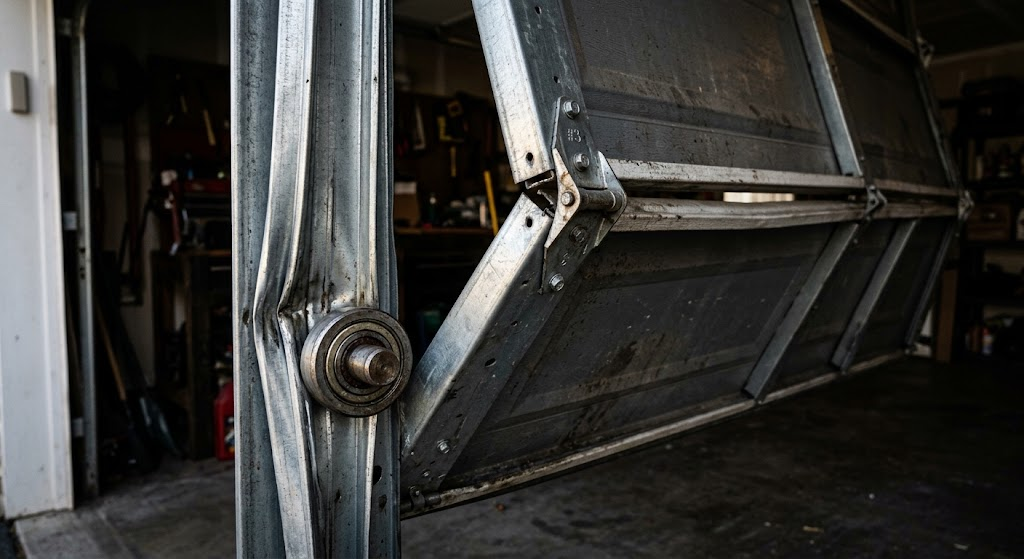
An off-track garage door is one of the most alarming faults a homeowner encounters. The door hangs at an angle, one side several inches ahead of the other, sometimes with a roller visibly out of its channel and the whole assembly looking like it is about to come down.
It also happens to be the fault where the instinctive response, grabbing the door and pulling it straight, causes the most injuries. Here is what is actually going on and what to do instead.
How a Door Comes Off Track
A sectional door hangs from rollers running inside steel tracks on both sides of the opening. It is counterbalanced by springs, and lift cables carry that balance down to the bottom corners of the door. The entire system depends on both sides moving together, in the same plane, at the same rate.
Anything that breaks that symmetry pushes the door out of its channel. In practice there are five common causes.
Impact. Backing a vehicle into the door is the single most common cause and usually damages the bottom section as well.
A broken or slack cable. If one cable snaps or slips off its drum, that side loses support instantly and drops while the other stays up. The door racks and the rollers pop out.
Ice. Meltwater freezes the bottom seal to the slab overnight, and in the morning the opener applies full force to a door that is stuck at the bottom. One side breaks free, the other does not.
Worn rollers. A roller with a seized bearing stops rotating and starts dragging. Over months it wears the track and eventually jumps out of it.
Track damage. Bent tracks, loose brackets, or a track that has shifted away from the jamb create a pinch point the roller eventually loses.
The Warning Signs Come First
Off-track failures are rarely genuinely sudden. In almost every case the door has been signaling for weeks.
A grinding, scraping or rhythmic clacking noise during travel means a roller is not rotating. A door that meets the floor at an angle is already running out of square. Uneven gaps between the door edge and the jamb, measured top and bottom on both sides, indicate the same. And a door that shudders at a particular point in its travel is binding on something.
Any of these is a straightforward service call. All of them together is a rescue.
What Not to Do
Do not run the opener again. This is the mistake that turns a cheap repair into an expensive one. Repeated attempts against a jammed door bend tracks, deform sections, elongate hinge holes and snap cables. Four seconds on the button can add several hundred dollars to the bill.
Do not try to lift or reseat it by hand. A residential door weighs 130 to 400 pounds, that weight is held by springs under extreme tension, and once the door is off track the load path is no longer the one the system was designed around. Sections can pivot, a partly supported door can drop, and the pinch points between sections close with enough force to break fingers.
Do not pull the emergency release with the door partly open. Releasing a jammed door in the raised position disconnects it from the only thing holding it. If the door is fully closed and stable, the release is fine.
And do not touch the springs, cables or drums under any circumstances.
What to Do Instead
Stop using the door entirely, including the opener. If a car is inside, leave it there or arrange to have it moved once the door is safe. If the door is stuck open or partly open, keep everyone out of the opening, including pets, and do not let anyone walk under it to get to the house.
Then call for garage door off track repair rather than attempting to reseat it. Most cases are resolved in a single visit.
How the Repair Works
A technician will first secure the door and release spring tension in a controlled way, so the assembly can be handled safely. That step alone is the reason this is not a homeowner job.
Then the rollers are reseated or replaced. Rollers that have come out of a track have usually been damaged in the process and are cheap enough that replacement is standard practice.
The cables and drums are inspected, because a cable that slipped its drum is often the underlying cause rather than a consequence, and a frayed cable needs replacing regardless.
The tracks are checked for straightness and the brackets for security. Bent track sections are straightened or replaced, and loose lag bolts into the jamb are re-secured.
The door is then re-squared, spring tension is restored and adjusted, and the balance is tested by hand before the opener is reconnected. Finally the opener force and travel settings are re-set, since a door that has been running out of true has usually had its force setting crept upward to compensate.
Preventing the Next One
Three habits prevent most off-track failures. Lubricate the rollers, hinges and bearings twice a year with a proper garage door lubricant, keeping the tracks themselves clean and dry rather than greased. Keep the threshold clear of standing water and ice, particularly if the driveway pitches toward the garage. And watch the door travel once a month for thirty seconds, which catches nearly every developing alignment problem long before it becomes a failure.